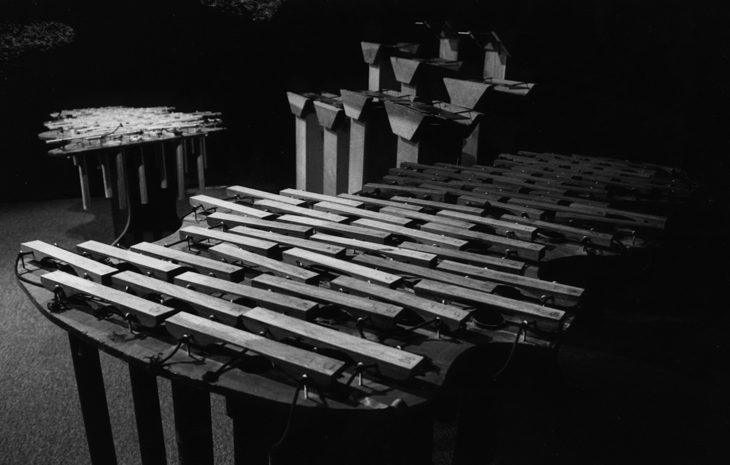
This is two backstage views of some of the more important instruments of the Shadow Theatre of Anaphoria. The instruments range from the original to recycled instruments to lessen the impact on endangered woods as well as to give new life to those discarded by newer technology.
Here the setup is in preparation of an all night dream performance used as a preliminary ritual for the performers themselves. Individual instruments can be seen below.
THE TREE II
Here is a newer version of an instrument known as THE TREE is found in only a few special older ensembles. This one is even more special in having with two branches instead of the original one (seen below here) allowing greater melodic material available. Since the bars when struck rotate, it provides an interesting phasing like effect not possible with rigidly suspended bars.
THE MERU BARS
One of the lowest instruments made on the Island is known as THE MERU BARS. Due to their depth and power they are a willing inclusion of the shadow theatre ensemble
Pictured is a subset of 9 of the existing 12 Meru bars tuned to this scale. Different subsets are used for different shadow productions.
THE BASS MARIMBA
Going even lower is THE BASS MARIMBA, is one of the newest addition to our ensemble shown here before the addition of the bench needed to play the instrument.
THE ESCALADE
THE ESCALADE represents the highest of all the Metaslendro instrument, It Is also the longest, reaching almost 3 meters. The layout allows for sweeps through the full scale.
THE GATE
Depending on the location of the shadow performance, the audience is often met with this instrument known as THE GATE which serves to clear those entering of any unwanted residues of their ventures to the performance. The instrument in its present form is 6 bars covering different pentatonic chords which are played by scraping hard mallets in a downward or upperward motion. There are a few variations of the actual frames which this being just one option. Each chord is easily removable if a perfomer would like to carry it to move around a space. This replaces the former unison/octave distribution of the original which seemed too penetrating when used with the other instruments. The visal appearance remains the same as that pictured here.
THE POLES
THE POLES is a modular tube instrument of tubes suspended in the middle instead of their normal nodal points providing more volume and requires no resonator unlike conventional tube suspension. The tubes can be arranged into any order allowing both melodic patterns and or chordal arpeggios that can be sweeped from side to side. Similar in effect to tubular chimes in sound but with more sense of pitch.
THE METALLOPHONES I, II, & 111
showing METALLOPHONE 11
As word spread, such retunings were applied to the vibraphones and other instruments that had not been destroyed. At first, the tuning comprised just two sets of Pentatonics, one slightly higher than the other.
Because of Erv Wilson, who traced the origin of the traditional scale to a great sage, we now know it was derived from a 4,000 year old diagram called Meru Prastara in India. Thus the two remaining tones could be incorporated into a 12 tone scale implied by the diagram allowing some modulations consistant with it tradition (more can be found on this scale in the Wilson Archives under The Scales of Mt.Meru). Although appearing like their western counterparts, they bear little or no common ground with the tuning from which they have been changed. Due to their compact size most of these have found a home in the Shadow
Theatre
The above instrument has now been extended (2017) to a 17 tone scale.
THE TWO WINDS
In the late nineteenth century, there occurred on our island what is known as 'The Great Missionary Expulsion'. As a result, many western instruments had to be abandoned by their owners. After being shunned for years, an instrument builder from Lipari realized that the reed organs could be retuned to a Slendro-like scale. Very pleased with the sound, he incorporated it into his ownpre-existing ensemble and we have done likewise. Presently there are two reed organs in working condition but the second one has been expanded to a 17 tone scale seen below. Please note the pattern of black and white notes.
THE FOSSILS
THE FOSSILS (pre-painted) gets it name from looking like those region on the island where both the skeletons of both whale and schools of small fish can be found. This instrument expands the normal 12 tone range of Meta-Slendro to 17 tones set up in a generalized pattern. The arch is adjusted to the individual player making the movement easier and more grace like.
Other metallophone like instruments exist including a 4 octave returned marimba, song bells, two bowed psalteries, and other small instruments.
LAKES AND MESAS - The Combination Product Set Ensemble
(older ensemble presently in reconstruction)
Above are some of the most common Anaphorian
instruments;
Lake Aloe (vibraphone-like instrument), Mt. Meru (bass bars), and Fifth Mesa
(marimba)
Lake Aloe spans 2 1/3 octaves and is a 22-tone instrument in the
tuning known in the west as an Eikosany (Wilson 1969), constructed out of
the harmonics 1-3-7-9-11-15. See more on the Eikosany below. Built and
reconstructed with David Mota.
lakealoe.mp3
This is only one of the many versions of Mt. Meru found in Anaphoria
in both tuning and layout. This particular instrument encompasses 9
tones
from the same Eikosany as Lake Aloe. Built and reconstructed with David
Mota.
stolenstars2.mp3
Fifth Mesa, a marimba-like instrument made out of Padouk, spans 3
1/3 octaves, extending an octave lower than Lake Aloe. Built and
reconstructed
with David Mota.
This instrument known as the Crib of Brass was destroyed while in
Los
Angeles during the Northridge Earthquake. Its tuning of 36 tones to the
octave contained a full Combination Product Set using 1-3-5-7-9-11
(more
below under tuning)
Last of the instruments in this tuning but second in age only to the Crib above is called the Tree. The tuning was to the 20 member Eikosany hanging in 10 tone star pattern with the flanking harmonic and subharmonics series hanging like two ladders. Newer versions of the Tree have been built and can be seen above.
CENTRAL VILLAGE ENSEMBLES - 9 tone Meta-Mavila
It is the Anaphorian Hammer Dulcimer instruments that seem to have adopted this tuning. Often found with a reed organ with only 9 tuned reeds. in progress is a 9 tone vibraphone and a bass marimba.
[pics in progress]
SCALES
The great influx of immigrants to Anaphoria since time immemorial
has brought many of the wide variety of scales now thought of as
Anaphorian.
In many cases the mother culture is apparent while in others the
origins
disappear into ancient prehistoric traditions almost impossible to
penetrate.
The problem is also complicated by the fact that these scales' proximity
to each other have produced a myriad of cross-interpretations,
influences
and even hybrids.
Anaphorian legend states that music was given to mankind by the
Earth
goddess Danae and Sky god Kukuk. It was in the famous cave of Celudore
where they would meet in embrace. In gratitude to their hosts, they
left
behind a stone carving over the opening of the cave. This tablet, the
Tablet
of Celudore (shown above), is one of the most ancient artifacts in
Anaphoria.
Archeologist have placed the dates of this tablet between 8,500 to
3,700
years old with a preference for earlier estimates. Composed of unknown
cryptic symbols, it took the Indian mathematician Deep Kama to realize
it as a representation of a figure known in her country as Mt. Meru
(known
also as Pascal Triangle, seen below, in the west). Kama conceded that
being
older than its counterpart in India opens up the possibility of the two
sharing a common origin.
As manifestations of sacred impulses, Anaphorian scales exhibit very
specific constructs inspired by organic as well as geometric analogies.
Numbers in Anaphoria are seen as "divine objects" found in the creative
imagination that function as the intermediary between the spiritual
and
the material. In this inner "temple" these two worlds are seen to
coexist
and only in this temple do new scales come about. Observation has
caused Anaphorians to believe that whereas a plant still preserves it first limbs and
branches throughout its growth, scales preserve their more ancient
forms
yet develop into predictable but unexpected constructs. With the
realization
of scales into concrete instruments, this inner temple becomes an
outer
temple that encompasses whole groups of people in a shared experience.
In the 1980's, individuals in Anaphoria first became aware of
various
scales of the American/Mexican theorist Erv Wilson. For the next few
years
there existed a great controversy over the coincidence that his scales
and systems appeared to solve many of the dilemmas confronting
Anaphorian
theory that had developed into heated debate The outcome of this
controversy
was the rejection of his scales by "official" academic circles only to
find the masses of practicing musicians and ensembles widely
adopting
his scales. On the other hand many of these people were disappointed that
Wilson
did not (at least publicly) share there own spiritual conceptions. He
did
in fact exhibit respect for their inclinations.